 Skip to content


- Why the Screen Time Fight Keeps Happening
- The 3 C’s: A Calmer Way to Handle Screens
- C1: Connect Before You Make Rules
- C2: Co-create the Plan Together
- C3: Celebrate What Goes Right
- Getting Support With Screens and Everything Else
It’s 7:15 on a school night. You ask your teen to put the phone away and start homework, and you get a quick “okay.” Twenty minutes later you pass their room, and the phone is still in their hand. You repeat yourself. They insist they’re almost done. Now you’re both irritated, the homework still hasn’t started, and you’re wondering how one small device became the biggest source of tension in your home.
If you’ve already tried taking the phone, setting time limits, or writing rules that fell apart after two days, you haven’t failed. Here’s the main idea we want you to take from this post: most screen time rules break down because they’re made for teens instead of with them. When your teen helps build the plan, they have a reason to follow it. Below, we walk you through the approach we use with families, called the 3 C’s: Connect, Co-create, and Celebrate.
Why the Screen Time Fight Keeps Happening
Before changing your approach, it helps to know what’s happening in your teen’s brain. Researchers at Weill Cornell Medical College scanned the brains of children, teens, and adults as they looked at emotional faces. Teenagers showed a much stronger reaction in the amygdala, the brain’s threat detector, than either younger kids or adults.
So when you interrupt a scroll with “Put that away, now,” your teen’s brain may read it as a threat. A brain that feels threatened switches into defense mode. That’s where the eye roll, the flat “okay,” or the slammed door comes from.
There’s a second piece too. A 2022 Stanford Medicine study found that around age 13, teens’ brains start to find unfamiliar voices more rewarding than their mom’s voice. The researchers see this as part of how teens naturally begin to separate from their parents.
We know that can sting to read. But it’s actually a healthy sign. Your teen is becoming their own person and wants a voice in their own life. When a rule is simply handed down, it can feel like that voice is being taken away. Your job isn’t to fight that instinct. It’s to work with it.
Most screen time rules fail for one reason. They get made for your teen, not with them.
The 3 C’s: A Calmer Way to Handle Screens
The 3 C’s give you a simple order to follow, so screen time stops being a nightly standoff and becomes a plan your teen helped write.
- Connect: build the relationship outside of the rules, and talk at a calm moment
- Co-create: ask questions, listen, and build one system together
- Celebrate: name it specifically when your teen follows the plan
C1: Connect Before You Make Rules
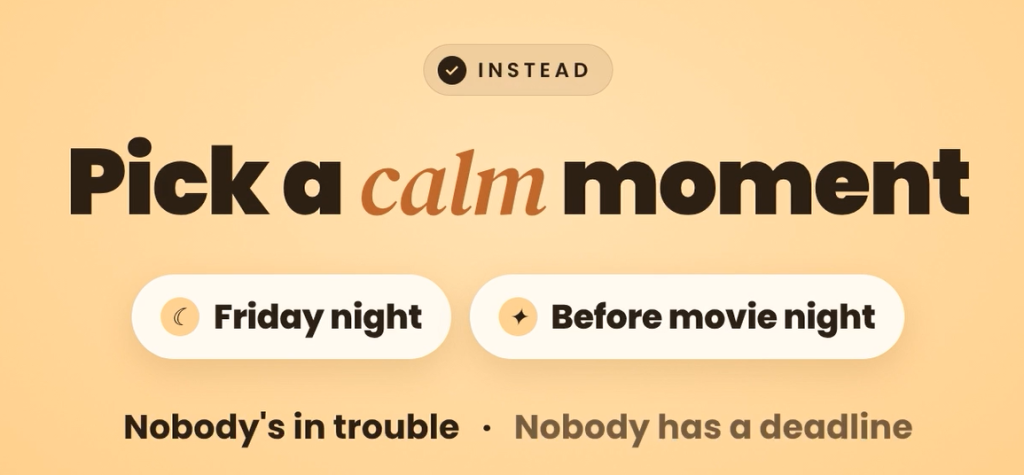
Connection starts with timing. The worst moment to talk about screen time is in the middle of a screen time argument. When everyone is stressed, nobody’s brain is open to solutions, and that includes yours.
Choose a calm window instead, like a relaxed Friday evening or the stretch before a family movie night. Nobody’s in trouble, and nobody’s racing a deadline. That’s when your teen is most willing to reflect and work with you.
Connection is also bigger than a single conversation. Think honestly about what most of your recent exchanges with your teen have sounded like. If they’re mostly about the phone, unfinished homework, or a messy room, it gets hard for your teen to hear you, even when you’re right. We dig into this pattern more in why ADHD teens stop talking to their parents.
Research backs this up. A 2020 meta-analysis from University of Wisconsin researchers looked at how parents learn what’s going on in their teens’ lives. Of the strategies studied, warmth had the most lasting effect. Not stricter rules, and not more checking. Warmth. Teens who feel close to a parent share more with them.
Teens listen to adults they feel cared about by, and safe with.
The fix: this week, look for one or two moments that have nothing to do with screens or school.
- Ask about the show they’re watching
- Have them teach you the video game they play
- Watch a few TikTok videos together
This is the foundation of the plan.
A quick note on age: middle schoolers usually need more structure from you at the start, like keeping the phone in another room during homework, with you backing that up. High schoolers do better with more of the steering wheel. Let them choose the system and set their own check-ins, while you shift from enforcer to advisor.

C2: Co-create the Plan Together
With that foundation in place, you can build the plan together, and your teen takes the lead. Start with questions, not rules. Here’s a simple way to run the conversation.
- Ask two questions. “How does your phone help you?” and “How does it get in the way?”
- Listen and stay curious. If your teen admits they drift to TikTok during math, don’t pounce. Try “Thanks for being honest with me.” That’s how you earn more honesty next time.
- Ask before you share. When it’s your turn, try “Can I tell you what I’ve been noticing?” Asking permission signals a conversation, not a lecture, and a teen who said yes is far more ready to listen.
- Pick one problem and build one system. Don’t try to fix everything at once. Choose the single biggest way the phone gets in the way.

For many of our students, the biggest problem is that the phone pulls their focus when they need it most. Here are a few systems we’ve seen work well for that.
- During homework: the phone goes in a drawer or another room until the work is done, or an app blocker like ScreenZen keeps only school apps available
- At bedtime: the phone is put away at a set time, ideally charging outside the bedroom, so your teen can wind down and sleep
What matters most is that your teen helps choose the system. When the idea is theirs, they aren’t pushing back against you. They’re following through on their own plan. If homework is where most of your screen battles happen, our guide on avoiding homework fights with your ADHD teen has more ideas.
When it’s their idea, they’re not fighting you. They’re following through on their own plan.
C3: Celebrate What Goes Right

This is the step parents skip most often. When your teen sticks to the plan, notice it out loud, and be specific. For example: “Thanks for putting your phone away while you did your homework,” or “I saw you plugged your phone in before bed. Nice work.”
It may feel too small to matter, but it isn’t. In a brain imaging study at Leiden University in the Netherlands, teens received praise and criticism presented as coming from their own parents while they were in an MRI scanner. The praise lifted their mood, and the criticism pulled it down.
Your words land with your teen, even when it looks like they’re tuning you out. Naming a specific win shows them exactly what to do again. That’s positive reinforcement, and with our students it’s one of the biggest reasons a system lasts.
The fix: for every reminder you give about the phone this week, aim to give one piece of specific praise when your teen uses it well.
Getting Support With Screens and Everything Else
Connect with your teen outside the rules, co-create one system together during a calm moment, and celebrate specifically when they use it. None of this works overnight, and there will be off days. Consistency is what turns a plan into a habit.
Once a screen time plan is in place, many parents run into the next layer: missing assignments, late-night homework, and still being the one who tracks it all. That’s why we built our Catch Up, Keep Up program. Your student works one-on-one with a coach each week to co-create systems for screens, homework, and whatever has piled up, with subject help included. Between sessions, their coach checks in, sends reminders, and keeps them accountable, so you aren’t the only one holding the line. You’ll also get session notes after every session. If that sounds like what your family needs, you can learn how the program works and apply for a Family Consult here, or explore all of our options on our services page. Spots are limited.
Which of the 3 C’s will be the hardest for you to try this week, and why? Tell us in the comments below.


